
An employee who takes a short training course on a professional software can sometimes gain more benefits than a diploma obtained ten years earlier. Continuing education is based on this simple observation: the skills acquired at the beginning of a career are no longer sufficient to meet the needs of a position that evolves every year. Investing in lifelong learning means maintaining one’s ability to act in a continuously changing professional environment.
Skills and obsolescence: what the job market really demands
Have you noticed that a digital tool mastered three years ago can become marginal today? This phenomenon affects all sectors, not just tech.
The Future of Jobs Report 2025 from the World Economic Forum highlights that upskilling and reskilling are now part of corporate strategy, not just human resources. Executive management integrates skills planning into their decisions just like financial management.
In practical terms, an accountant who has never used automated invoicing software finds themselves at a disadvantage compared to a recently trained colleague. The difference lies not in talent, but in the regular updating of knowledge. Understanding best practices in training helps structure this approach to produce tangible results.
Skills obsolescence is not limited to technical jobs. Interpersonal skills, written communication, and project management are also evolving. Regular training protects against professional disengagement, regardless of the field of activity.
Corporate training: going beyond the catalog of courses
Many companies offer a catalog of annual training courses. Employees check a box, complete a module, and everyone moves on. This model produces few lasting effects.
An integrated approach to daily work
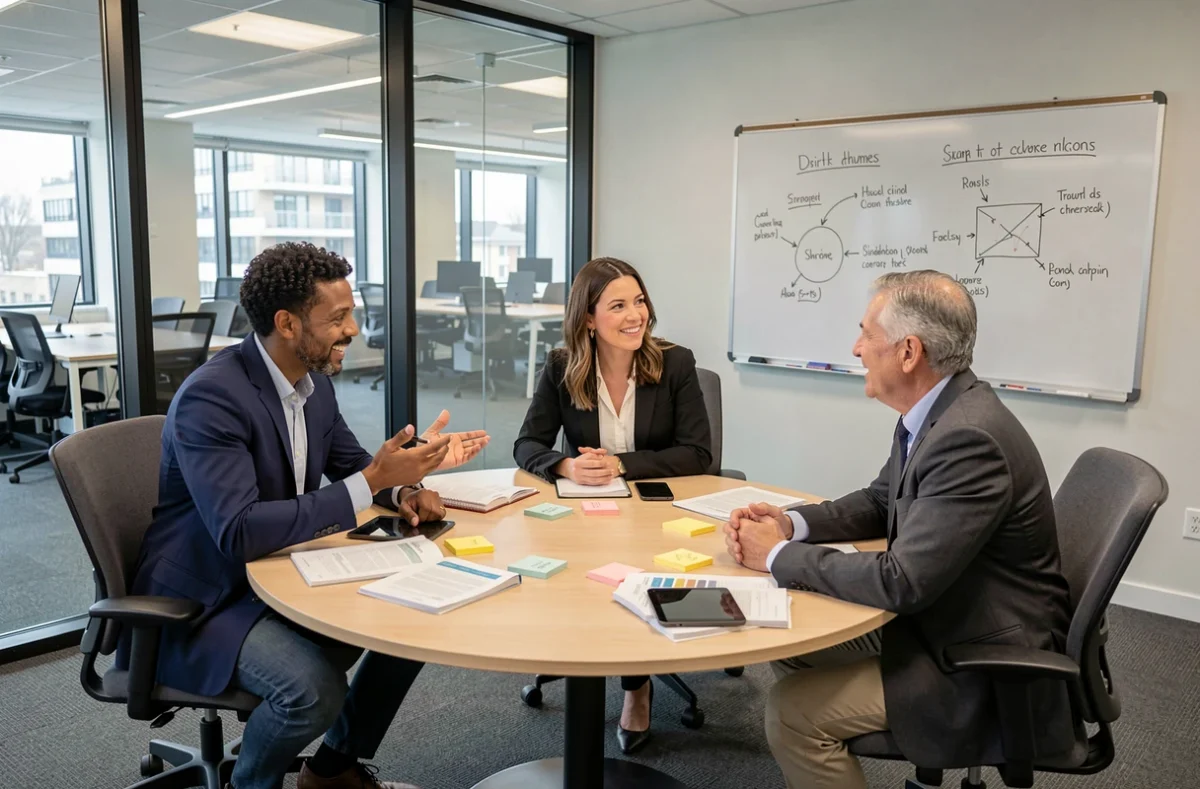
Effective training is embedded in the work itself. For example, a sales team that dedicates one hour per week to analyzing their client calls together progresses more than by attending a two-day annual seminar.
Peer learning, grounded in real situations, strengthens skills more sustainably than a theoretical training disconnected from the field. Companies that achieve results invest in short, repeated formats directly linked to the team’s objectives.
What this means for managers
The role of the manager is changing. They no longer just validate training requests. They identify skill gaps within their team and organize learning conditions.
- Allocate dedicated training time within the weekly workload, not just during the employee’s personal time.
- Associate each training with a measurable operational objective (for example, reducing the processing time of a specific task).
- Gather feedback after each module to adjust the development path.
Without this framework, training remains a perceived social benefit, not a performance lever.
Accessibility of training: an often underestimated issue
Access to continuing education is not the same for all employees. This is a rarely addressed angle, yet it is documented.
The report from the General Inspectorate of Social Affairs (IGAS) dedicated to ten years of evaluating apprenticeships points out an underrepresentation of the most disadvantaged groups in training programs. The offerings are concentrated in urban areas, and the quality of organizations varies greatly.
For an employee in a rural area or on a precarious contract, accessing relevant training requires more effort. The barriers are concrete: geographical distance, incompatible schedules, lack of awareness of rights.

Evaluating a training policy by its real effects
Counting the number of people enrolled in a training course is not enough. The quality of a training policy is measured by its accessibility and its effects on career paths. A company that trains its managers en masse but leaves its field employees without support creates an internal skills gap.
Several criteria can help verify if the approach is truly inclusive:
- Are training sessions offered in person and remotely to cover different geographical situations?
- Do part-time or temporary employees have access under the same conditions?
- Is there post-training follow-up, with support to apply the acquired skills on the job?
Lifelong learning and personal development
Continuing education is not just about calculating return on investment. Learning something new changes the way one perceives their work.
A maintenance technician who takes a project management course discovers that they can coordinate a team. An administrative assistant who learns to use a data visualization tool gains access to tasks they never imagined. Training opens up professional trajectories that would be invisible without it.
This benefit extends beyond the company. The skills acquired, whether in communication, problem-solving, or mastering a tool, are useful in other contexts. They enhance confidence in one’s ability to adapt, even in the face of a job or sector change.
The French training market is entering a phase where public spending is tightening and quality criteria are becoming stricter. For employees as well as companies, choosing targeted and evaluated training produces more effects than accumulating course hours. The most useful continuing education is that which meets an identified need, not that which fulfills a quota.