
A wooden cutting board that shows deep cuts, warping, or areas blackened by moisture no longer serves its food function. Before sending it to the trash, we recommend assessing the condition of the wood to choose the appropriate route: reuse as is, transformation, or material recovery.
Assessing the condition of the wood before any recycling decision
The first instinct is to identify the wood type. A board made of beech, maple, or olive behaves differently when sanding or gluing. Open-pore woods (beech, ash) absorb more juices and fats, making their food rehabilitation more delicate once the surface is degraded.
Further reading : How to Manage Your Online Academic Messaging: Tools and Tips to Know
We distinguish three levels of degradation. The superficial level (scratches, light stains) can be corrected by progressive sanding, from grain 80 to grain 220, followed by an application of food-grade oil. The intermediate level (deep cuts, slight warping) excludes a return to the kitchen but leaves the door open for transformation. The advanced level (through cracks, mold, spongy wood) points towards material recovery or composting.
A detail often overlooked concerns the glues used in glued boards. Some wood glues do not withstand water well and eventually give way, creating open joints that are impossible to sanitize. For this type of board, food reuse is to be ruled out, but the structure remains usable for decorative or utilitarian projects. To delve deeper into the recycling of wooden boards on Chapeau Melon, the sorting and recovery channels are detailed according to various scenarios.
Recommended read : How to Buy and Sell Between Individuals Using an Online Classifieds Platform
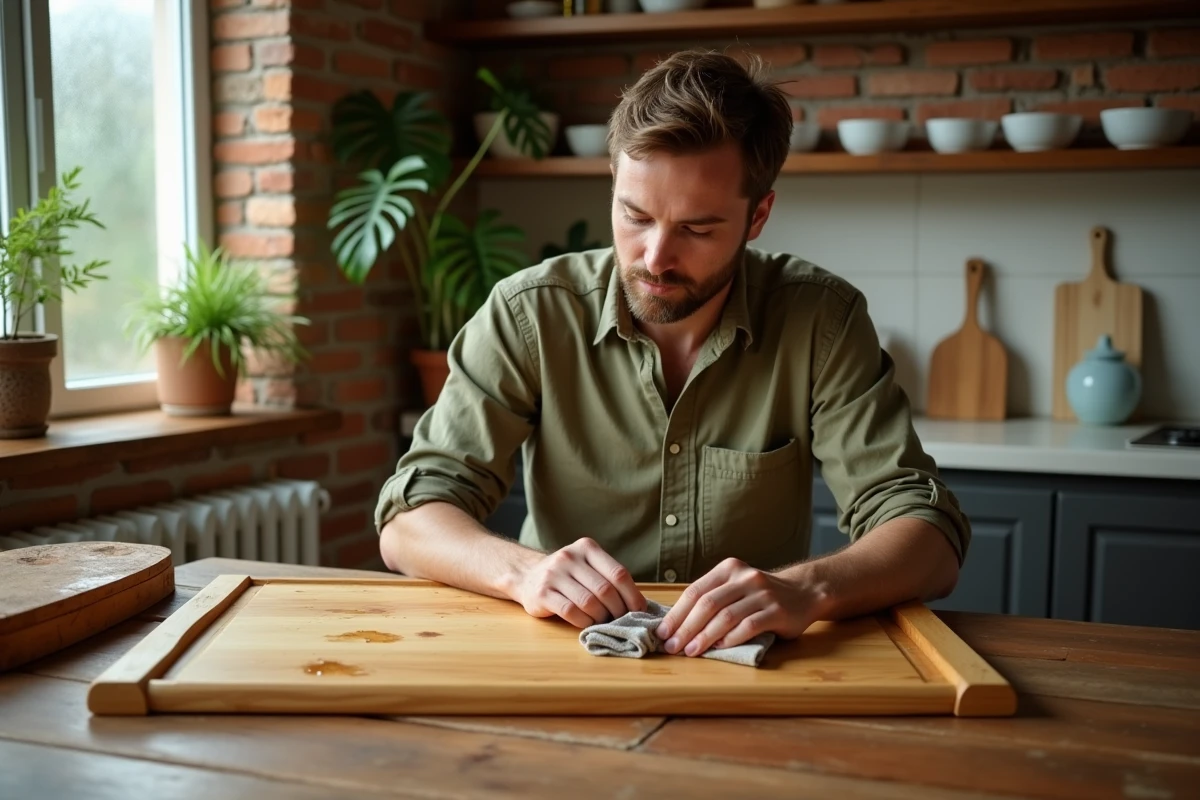
Transforming a cutting board into a utilitarian object for the home
When the wood remains sound but the board has lost its culinary purpose, transforming it into an everyday object is the most straightforward solution. We favor projects that utilize the thickness and density of solid wood, two qualities absent in low-end panels.
Wall-mounted holder or trivet
A sanding with grain 120 is sufficient to prepare the surface of a trivet. Thick boards made of olive or walnut, once cleaned and oiled with a drying oil (linseed, tung), resist heat very well. Four felt pads glued under the board protect the countertop or table.
For a wall-mounted holder, drill two holes in the back and attach a batten or a brass hook. The board becomes a display for dried herbs, lightweight utensils, or a small bathroom shelf. The raw wood, left unvarnished, adds a touch of natural decoration without chemical treatment.
Serving tray or appetizer board
A board too damaged for cutting can still serve as a presentation tray. The condition: the surface must not have deep cracks that could trap food residues. A light planing, followed by a finish with food-grade linseed oil, restores a clean appearance. End-grain wooden boards are particularly suitable for this use, their checkerboard pattern becoming an aesthetic asset.
Material recovery: composting and wood recycling center
When the board is too degraded for a second use, two options for responsible recycling are available to you.
- Composting works well for untreated wooden boards, without varnish or synthetic glue. Cut the board into chips or small pieces with a saw. Raw wood decomposes slowly and acts as a carbon source in compost, balancing nitrogen materials (peels, clippings).
- The recycling center, wood channel, accepts cutting boards in the designated bin. The wood is shredded and then directed towards the production of particle boards or energy recovery. Check with your local authority that the wood bin accepts small pieces.
- Donating to a community workshop or a maker space allows the material’s life to be extended. Solid wood scraps are sought after for turning, marquetry, or making small objects.
A varnished or lacquered board should not end up in compost. Finishing products release undesirable compounds during decomposition. If in doubt about the surface treatment, the recycling center remains the default solution.
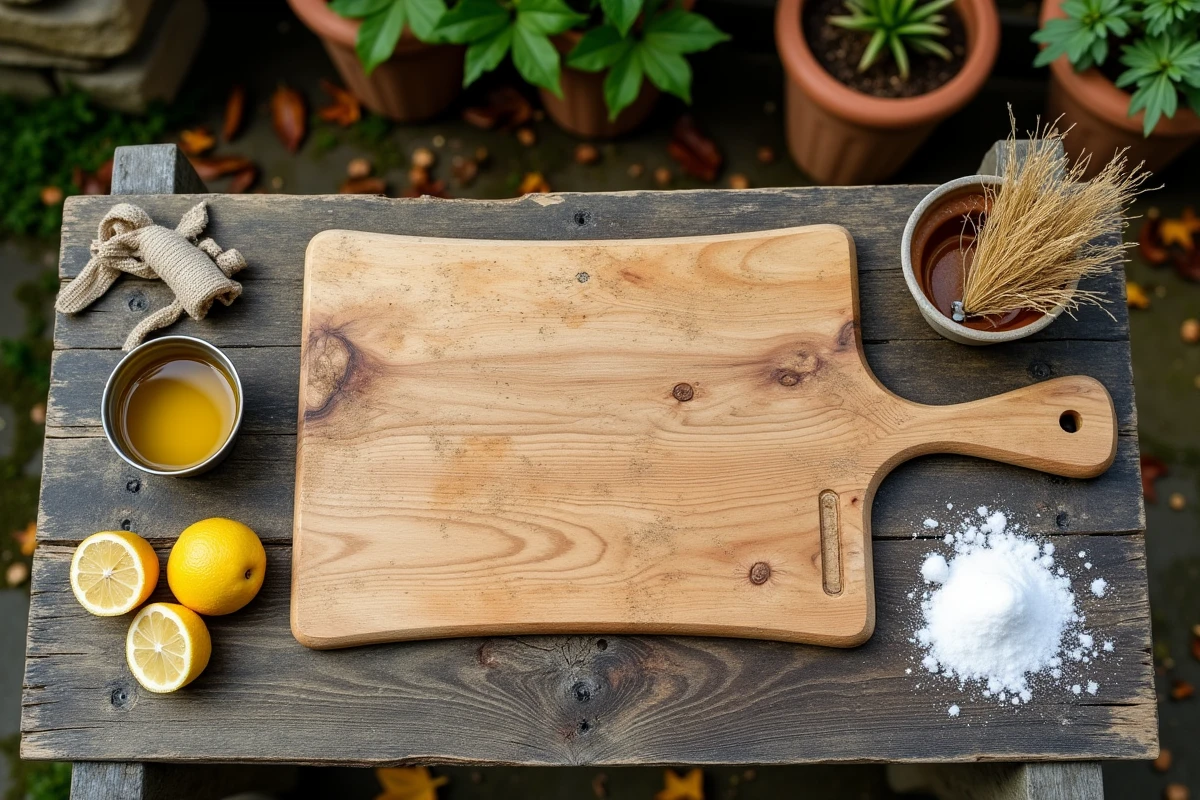
Preventive maintenance: extending lifespan to reduce waste
The best way to recycle less is to make things last longer. We observe that most boards end up in the trash not due to mechanical wear, but due to a lack of basic maintenance.
Oiling the board every two to three months with food-grade mineral oil (food-grade paraffin) prevents the wood from drying out, cracking, and absorbing odors. After each use, cleaning with coarse salt and lemon eliminates surface bacteria without damaging the fibers.
Storing the board upright, in a ventilated space, prevents moisture accumulation on the underside. This simple detail delays by several years the moment when the board shows signs of mold or warping.
Well-maintained solid wood retains its mechanical and sanitary properties for a decade or more. Recycling a wooden cutting board should only be a last resort, when maintenance or repair are no longer sufficient. Whether the choice is to transform it into a utilitarian object, donate it to a workshop, or direct it to the recycling center, each route prevents the material from ending up in landfill.