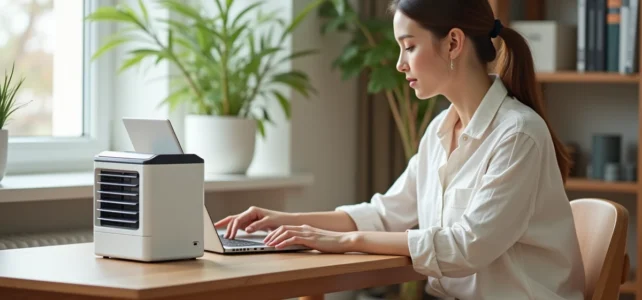
The Silvercrest mini air cooler (model STLKS 12 A1, distributed by Lidl) operates on an evaporation principle combined with a misting function. Its effectiveness directly depends on how it is positioned, how the water reservoir is managed, and how ambient humidity is controlled. Here, we detail the technical points that make the difference between a disappointing device and a truly comfortable use.
Positioning the Silvercrest mini cooler: the variable everyone overlooks
The effective range of this type of tabletop device is limited to a very small area of coolness. Feedback on comparable models indicates that the perceptible effect does not exceed 0.5 to 1 meter in front of the air outlet. Expecting a global cooling of the room, as an air conditioner would provide, inevitably leads to disappointment.
You may also like : Discover how to enhance your daily well-being with practical tips
The placement rule is simple: the device should be at face height, on a desk or bedside table. Placed on the floor, the flow of cool air dissipates before reaching the useful area. If you use it for sleeping, place it on the nightstand, directed towards the upper body, at arm’s length.
We recommend avoiding placing it facing a wall or in a corner, as this blocks air circulation and further reduces the flow’s range. A clear space in front of and behind the device ensures optimal operation of the evaporation mechanism.
Related reading : How to buy a cheap electric lawn mower?
A complete guide details how to use a Silvercrest mini air cooler while considering these placement and installation constraints.
Managing humidity in a closed room: the trap of the evaporative cooler
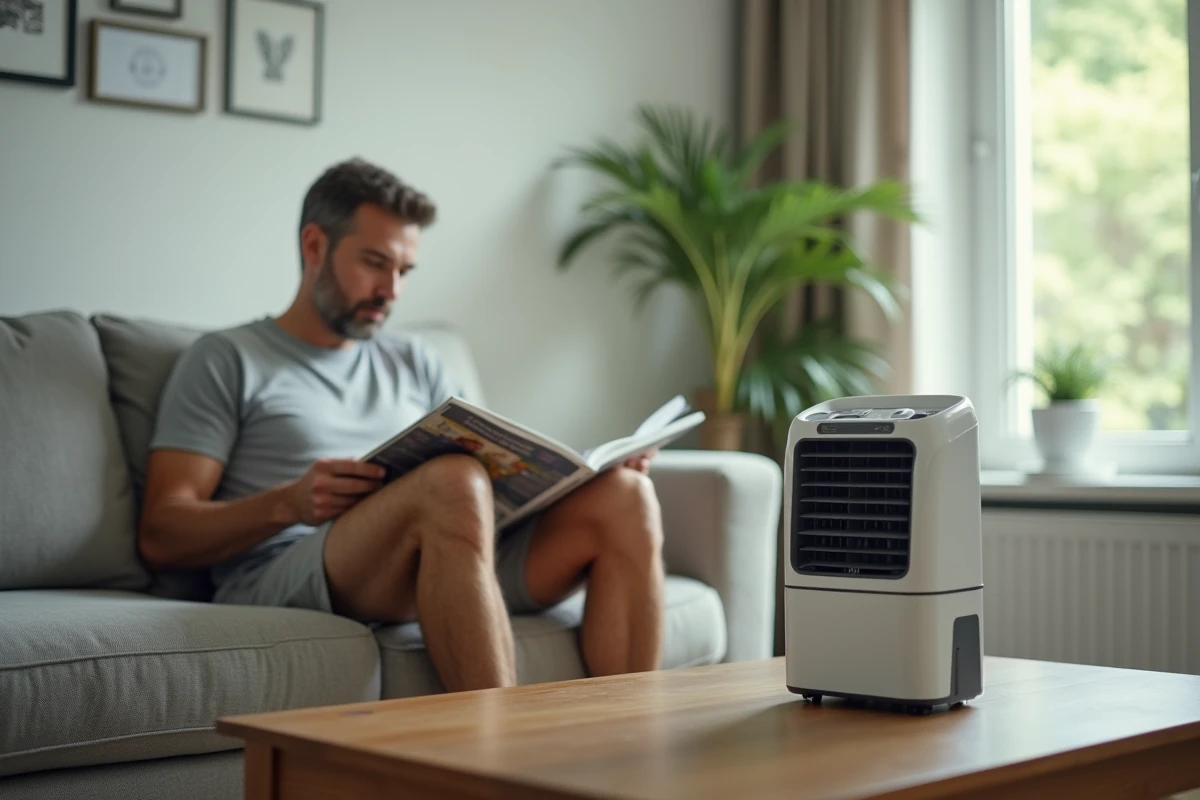
An air cooler works by evaporating water into the airflow. This water does not disappear: it becomes humidity in the ambient air. With prolonged use in a small closed room, the relative humidity can rise well above 60%, the threshold beyond which the device loses effectiveness and comfort degrades.
Above this humidity level, two problems arise. The first is physical: evaporation slows down in already saturated air, and cooling becomes nearly nonexistent. The second is health-related: continuously high humidity promotes the growth of mold and can worsen respiratory discomfort.
Aeration protocol to follow
We observe that most users run the device all night with the window closed. The best practice is to slightly open a window or door to allow for minimal air renewal. If ventilation is not possible, limit continuous use to sessions of about two hours.
- Check the humidity with a small hygrometer (a few euros at a hardware store) and turn off the device beyond 60% relative humidity
- Prefer the ventilation-only function (without misting) if the room is already humid or poorly ventilated
- In the morning, ventilate the room for at least ten minutes to expel the excess humidity accumulated overnight
Water reservoir and filter: technical maintenance of the STLKS 12 A1
The reservoir of the STLKS 12 A1 is compact, meaning frequent refills during intensive use. Empty and rinse the reservoir after each day of use, even if you plan to reuse it the next day. Stagnant water becomes a breeding ground for bacteria within a few hours at room temperature.
The cold accumulators provided with the device should be placed in the freezer for several hours before use. Adding them to the reservoir lowers the water temperature and significantly improves the feeling of coolness. Without them, the device blows air that is barely cooler than the ambient temperature.
Cleaning the filter and longevity
The paper filter that ensures evaporation gradually accumulates limescale and residues. We recommend rinsing it with clear water every two weeks during daily use. A clogged filter reduces evaporation flow and can potentially generate odors.
- Preferably use filtered or demineralized water to limit limescale deposits
- Visually inspect the filter: if it yellows, hardens, or disintegrates, replace it
- Completely dry the device (reservoir open, filter removed) before any prolonged storage to avoid internal mold
Silvercrest cooler or traditional fan: when to switch
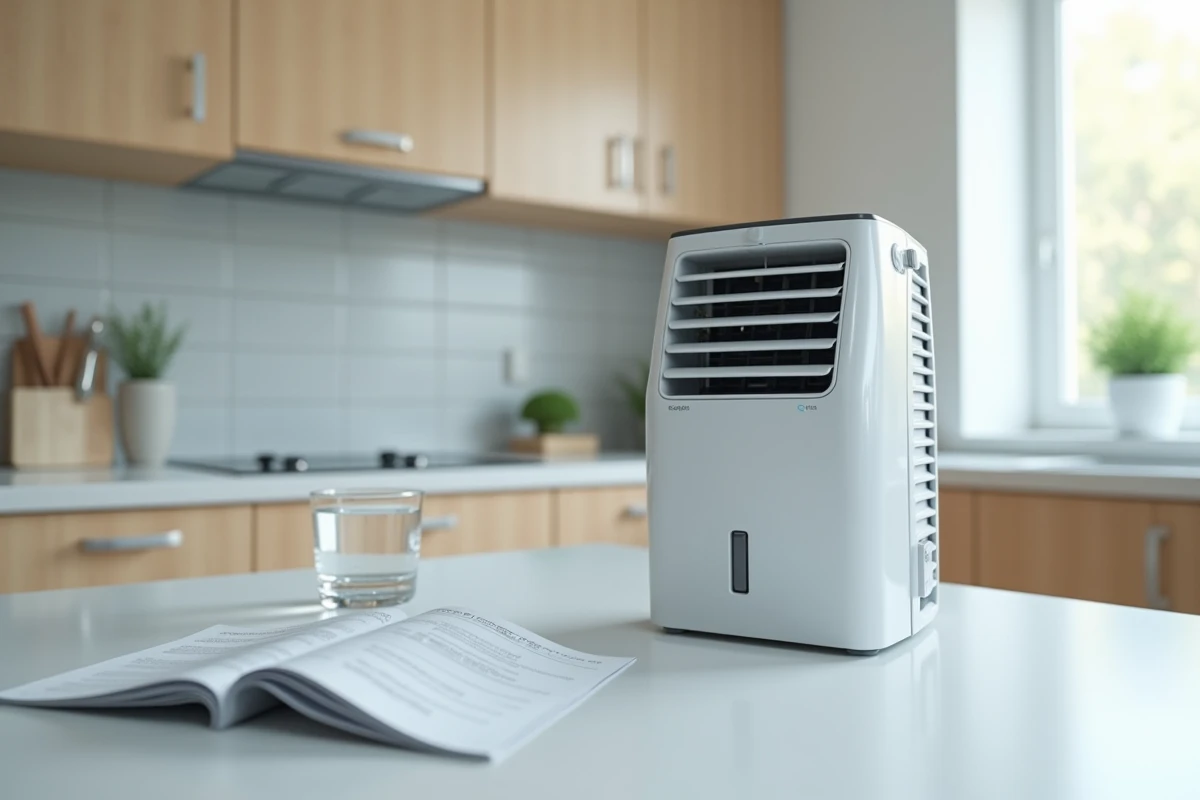
The cooler is not a substitute for a fan in all conditions. In already humid climates (coastal regions, stormy days), evaporation is ineffective, and the device only adds humidity without lowering the perceived temperature. In these situations, a simple fan produces a better result.
The Silvercrest mini cooler is most beneficial in dry climates or in air-conditioned interiors (dry air from central air conditioning) where localized cooling is sought. Its advantage over the fan lies in the combination of airflow and evaporation, which truly lowers the perceived temperature in its range.
In terms of electricity consumption, the device remains very economical compared to a portable air conditioner. The difference on the bill is negligible over a season of use, making it a relevant complement for a workstation or bedside table, not a cooling system for an entire room.
The key takeaway remains the positioning and humidity management. A properly placed, maintained, and sufficiently ventilated Silvercrest mini air cooler fulfills its function precisely: to provide a localized thermal comfort zone at a lower cost. Expecting more from it is a misunderstanding of the device.