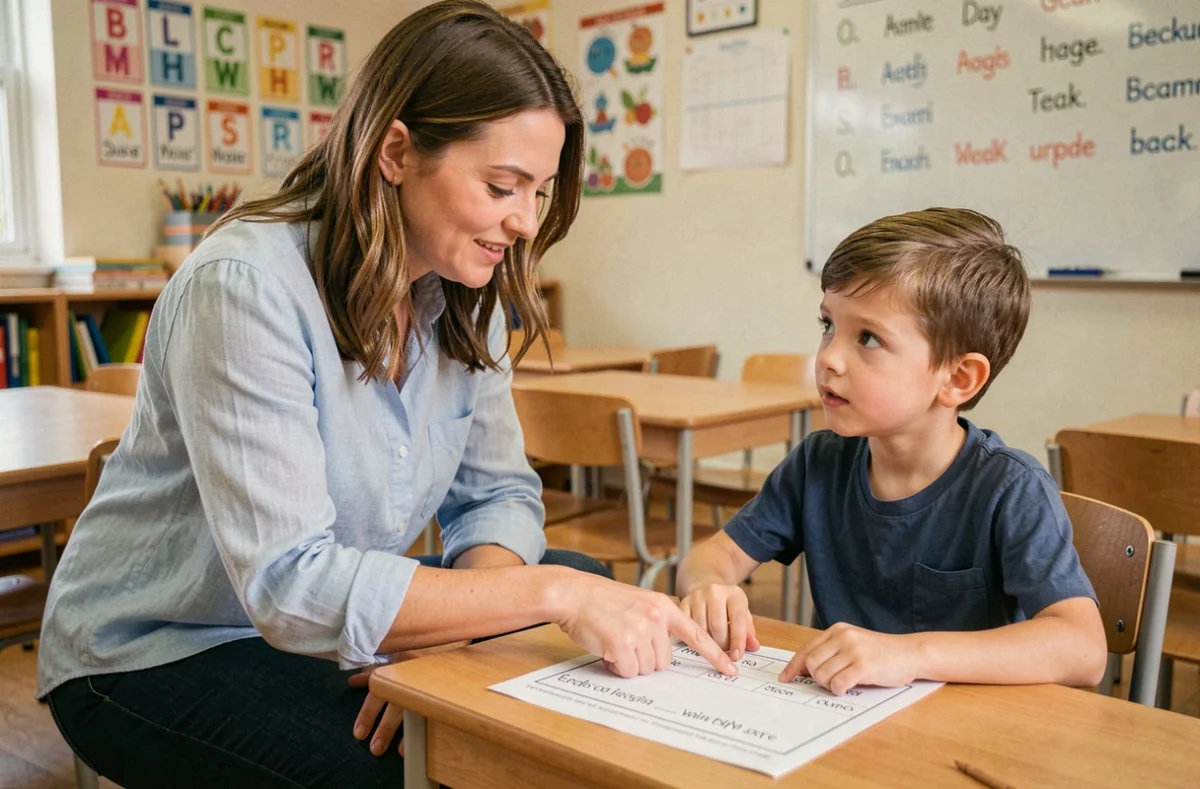
The decree of May 5, 2025, restructured foreign language programs by grade level, with an increased goal of B1 by the end of the third year and B2 by the end of high school. This enhancement places oral comprehension and spontaneous production at the center of the educational framework. Teaching English to children and adolescents now requires a didactic engineering calibrated to these levels, not just an accumulation of playful activities.
Phonological Acquisition Window: Structuring Input Before Cycle 3
The auditory plasticity of young learners gradually decreases after the age of eight. Effective English teaching for children takes advantage of this window by saturating the sound environment with authentic content: prosody, minimal pairs, schwa. Working on phonemic discrimination early conditions the quality of oral production in adolescence.
We recommend separating active listening phases from repetition phases. Active listening targets the segmentation of the oral flow (identifying where a word begins and ends), while repetition works on articulation. Mixing the two in the same exercise dilutes attention.
Teachers and parents seeking structured support from a native teacher can rely on resources like those offered at professeurdebbie.fr, where the oral approach takes precedence over grammatical rote learning.
For children in kindergarten and early primary school, singing and nursery rhymes remain the most effective vector for prosodic acquisition. The stress rhythm of English (a word-stressed language, unlike French) is better integrated through the body than through rules.
EMILE/CLIL Approach in Primary School: Teaching a Subject in English

The teaching of an integrated subject in a foreign language (EMILE, or CLIL in English) continues to spread in French primary schools. The principle is simple: subjects like science, visual arts, or physical education are taught partially in English, so that the language becomes a functional tool rather than an isolated object of study.
This approach produces results because it creates a real communicative need. The student does not repeat a grammatical structure for its own sake; they use English to understand a cutting instruction or to describe an experiment with magnets. The vocabulary acquired in this context becomes firmly established.
Implementing an EMILE sequence, however, requires precise framing:
- Identify a discipline with concrete and visualizable vocabulary (science, visual arts, sports), as the visual support compensates for the initial linguistic deficit
- Prepare a bilingual glossary distributed before the session so that students do not disengage from the first minute
- Alternate phases in English and French within the same session (recommended ratio: two-thirds target language, one-third source language for beginners)
- Evaluate disciplinary competence separately from linguistic competence, otherwise the student perceives English as an obstacle rather than a lever
Feedback from academies that have experimented with this system shows that students exposed to EMILE make greater progress in oral comprehension than those who follow a traditional English course with an equivalent number of hours.
Adolescents and Oral Production: Overcoming Emotional Blocks
In middle school, the main barrier is no longer cognitive but emotional. The fear of peer judgment inhibits speaking, and the whole-class format amplifies this phenomenon. A teenager who masters a structure in writing may become mute orally in front of thirty classmates.

We observe that the most effective systems reduce the size of the interaction group. Timed pair work (two minutes of speaking each, then rotation) generates a volume of oral production per student that is incomparably higher than front questioning.
The use of communicative tasks with information gaps forces exchange: each student holds part of the information needed to solve a problem. English is no longer an assessed performance; it is a means to fill a gap. This shift in posture transforms the classroom dynamic.
For adolescents, the content must also be credible. Artificial dialogues about “Tom’s family” no longer work past the age of twelve. Slowed authentic podcasts, excerpts from series with English subtitles, debates on current topics adapted to the level: the material must respect the intellectual maturity of the learner even when their linguistic level remains modest.
Guiding Generative AI in English Learning
Since 2025-2026, several educational authorities have restricted the autonomous use of generative AI by younger students while maintaining supervised uses for high school students. This distinction has a direct impact on English teaching.
For primary school children, AI does not replace human interaction in oral acquisition. A voice chatbot can correct pronunciation, but it does not perceive hesitation or frustration, and it does not adjust its pace based on the student’s gaze.
For adolescents, however, supervised AI offers a training ground for written production: writing an email, rephrasing a paragraph, negotiating the language register. The teacher sets the task and validates the result. The tool absorbs the repetitive draft phase, freeing up class time for oral practice.
The trap to avoid: allowing the student to delegate production rather than using it as a mirror. A clear protocol (submitting their version first, then comparing it with the AI suggestion, then justifying their choices) transforms the tool into a metacognitive lever.
- Primary: use limited to assisted listening (text-to-speech calibrated to the level), never for autonomous production
- Middle School: guided written production with systematic teacher validation
- High School: supervised oral and written practice, with critical analysis of generated outputs
The new programs by grade level facilitate this framing by setting precise expectations. An English teacher can now link each use of AI to an identified competency descriptor, which secures the pedagogical approach and reassures families.